.webp)
How can the recommendations from the Greater Melbourne City Portrait begin to influence policy and planning decision-making across the city? Director of Regen Melbourne's Systems Lab, Alison Whitten, explains how the City Portrait is shifting gears through 2025 and beyond.
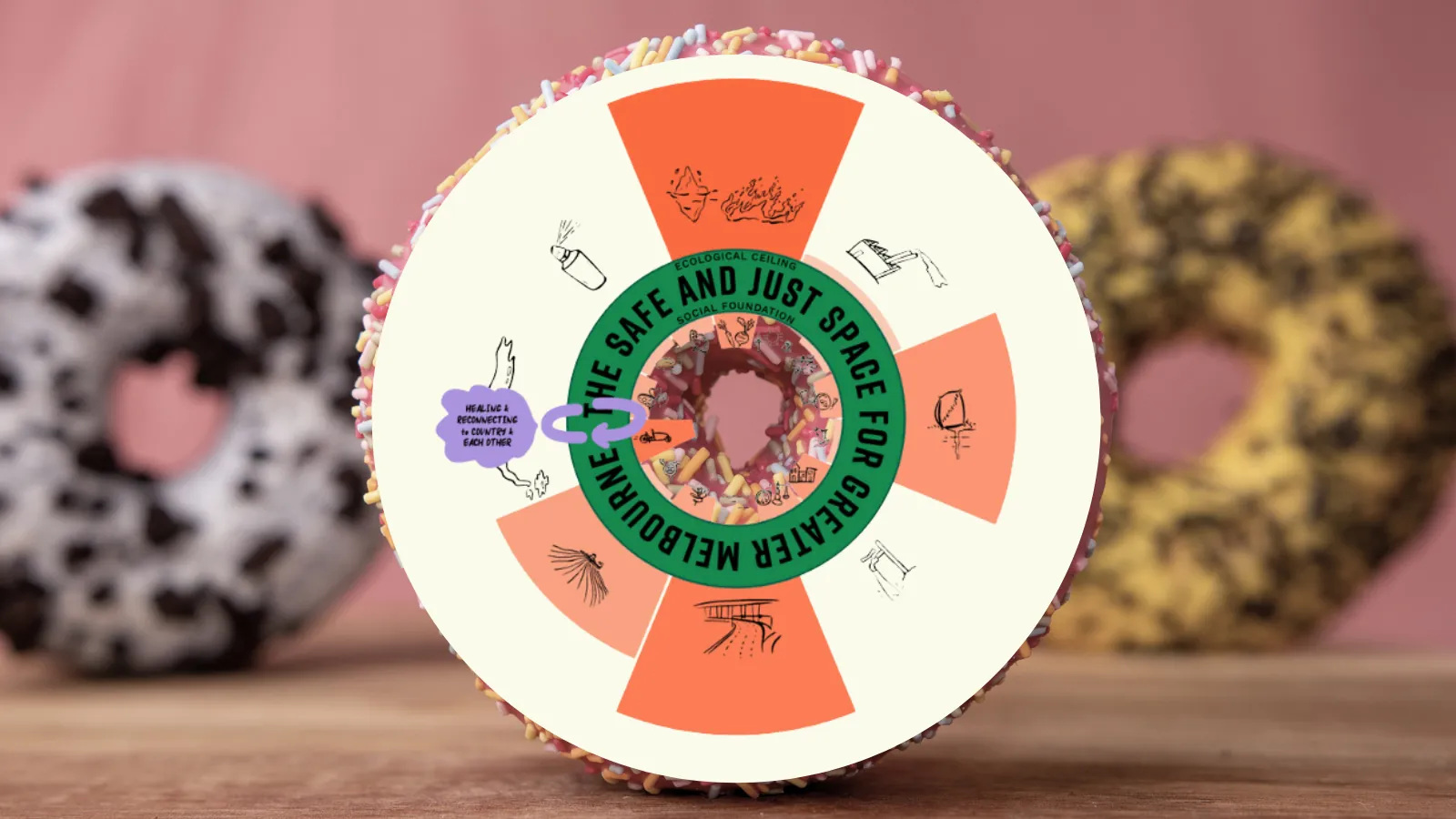
When we launched the Greater Melbourne City Portrait last year, tucked away behind the data and stories was a set of recommendations suggesting what is required to move towards the "safe and just space" for our city.
These recommendations are not easy, quick wins. They are clear, but they are also multi-faceted and based on new ways of working, calling on government, the market, civic society and each of us to contribute to meaningful change.
This year, we started to unpack these recommendations by delving into government policy analysis and submissions. We wanted to understand how applying the City Portrait model to government policy and planning could contribute to more holistic approaches that centre human and ecological wellbeing.
A Portrait for Victoria's Future
In collaboration with Navam Niles and Professor Sarah Bell at the University of Melbourne, we began with a comparative analysis between the City Portrait model and Infrastructure Victoria's Choosing Victoria's Future(CVF) scenario modelling. Infrastructure Victoria released this work just a month before the City Portrait launched. The CVF report compares the economic, environmental and social performance of five different approaches to future development across Victoria.
Titled A Portrait for Victoria's Future, our analysis corroborates this assertion, going further to suggest an important opportunity for the City Portrait to augment the CVF report, and other research-based initiatives like it that are informing current long-term government planning initiatives likePlan for Victoriaand theNational Urban Policy.
Comparing the Pair
In the analysis, we first identified key differences between the two methodologies and frameworks, noting, in particular, the more expansive set of indicators and metrics applied in the City Portrait. This comparison highlighted the following:
Scope and remit: The scope and remit of Infrastructure Victoria and Regen Melbourne differ, influencing the methodology applied to each framework.
Selection and availability of datasets: The two frameworks draw on different types of data: the CVF report focuses on economic metrics while the City Portrait reflects a diversity of social and ecological measures.
Political landscapes, data and decision-making: Most data sources disproportionately emphasise economic productivity, reinforcing policy and investment models that prioritise GDP over social and ecological outcomes.
We then considered the expected performance of the five CVF scenarios if we were to apply them to the City Portrait framework. This highlighted:
Partial doughnuts: The 'possible future City Portraits' illustrate the gaps in the CVF framework relative to the City Portrait model.
Appetite for change: The differences between the scenarios imply different assumptions about political will for change.
Limits to growth: The City Portrait places social and ecological dimensions in tension, and sets targets that highlight science-based limits to growth.
A clear picture emerges
We concluded that applying the City Portrait as a means of building on the CVF modelling can help to ensure that holistic social and ecological outcomes are more fully accounted for in planning and policy-making about Victoria's future. In summary, this work made clear the value of taking up the City Portrait as an alternative or additional approach to measurement, identifying three key opportunities:
Changing the goal ofwhywe measure;
Changingwhatwe measure to be more holistic; and
Changinghowwe measure to support more collective approaches.
Draft National Urban Policy submission
Led by volunteer research assistant Lokesh Sangarya, we developed a response to the Draft National Urban Policy(NUP), the Australian Government's approach to supporting urban environments across the country to be "liveable, equitable, productive, sustainable and resilient."
The submission began with mapping the social and ecological dimensions of the City Portrait to the elements of the NUP framework. This helped to surface three key findings:
First, we found that all elements of the NUP framework are represented in the City Portrait, and that the City Portrait's dimensions are more comprehensive than what is represented in the NUP.
Two key elements of the NUP are less evident in the City Portrait:
The City Portrait does not focus extensively on climate risk and resilience in relation to public infrastructure.
The City Portrait only lightly covers the NUP's objective focused on productivity, because the Doughnut Economics model is oriented around the economy being in service to people and planet.
Second, the City Portrait is designed to illustrate the relationships and tensions between social and environmental objectives. In contrast, the NUP focuses on improvement across multiple goals without demonstrating deeply how they might impact one another.
Third, the City Portrait defines measurable indicators and applies targets; the NUP does not yet have measurable elements articulated.
Our recommendations for government
Following this review, our submission concludes with a set of recommendations for the Federal Government:
Expand the scope of the National Urban Policy to incorporate all City Portrait dimensions and outcomes;
Utilise the City Portrait to identify and reconcile conflicting goals, objectives and interventions;
As an international first, apply the City Portrait model as a place-based, collaborative approach to roll out the National Urban Policy to specific urban areas; and
Use the example of the City Portrait to develop targets to drive ambitious action.
Plan for Victoria Submission
Finally, we provided a submission as part of the consultation on Plan for Victoria, the Victorian Government's 2050 state-wide plan that largely replacesPlan Melbourne.It is mostly oriented around a set of big ideas for Victoria's future.
Affordable Housing and Choice
Equity and Jobs
Thriving and Liveable Suburbs and Towns
Sustainable Environments and Climate Action
As noted in the plan's background documents, 80% of Victoria's population resides in Greater Melbourne. With this in mind, we suggested that the City Portrait is highly relevant to the scope and considerations ofPlan for Victoria.
These two parts of the submission came together in a number of recommendations for planners and policy-makers contributing toPlan for Victoria:
Create, support and adopt more holistic measures of progress, drawing on the City Portrait model and methodology.
Engage in (and invest in) deep collaboration, developing multi-sector governance structures to guide Plan for Victoria's completion and implementation.
Normalise integrated decision making and internalise negative externalities, applying the City Portrait to inform decision-making.
Shift capital towards systemic interventions by shaping new government and multi-sector investment architectures.
Increase Victoria's collective ambitions, creating mechanisms through the planning scheme and related policy.
Go out and smell the wattle, and create a plan that enables everyone in Victoria to spend more time in nature connecting to the places where we live, work and play.
We look forward to continuing this exploration next year of what it looks like to bring the City Portrait to life in practice. Please reach out to alison@regen.melbourne if you are curious or would like to discuss this work.