
New Urban Governance
How can we build our democratic muscle?

New Urban Governance

New Urban Governance
Context

Barriers in the System

Our existing modes of governance concentrate power and constrain constructive debate about how to respond to current and future challenges. Opportunities for genuine collaboration in decision-making are limited; engaging with democracy, therefore is too often seen as simply voting in elections, rather than fully participating in civic life. Within this construct, our understanding of leadership is synonymous with formal titles and forms of influence.

Additionally, unlike many other global cities of similar size, Greater Melbourne lacks the forums and institutions to make good, holistic decisions at a metropolitan scale. As such, there is a mismatch between the complexity of issues that we face as a city and the ways in which our institutions and communities are able to come together to address them.

Our response

What We're Doing

We are experimenting with participatory, distributed and adaptive models of decision-making that go beyond traditional top-down governance systems. We're asking how stronger relationships between communities and democratic systems can enable a thriving civic life for all, especially in the face of complex social and ecological challenges. In doing so, we hope to rebuild trust in our democracy and ensure that decisions being made about the future of our city are informed by the full diversity, expertise and lived experience of its residents.

This approach recognises that existing systems often limit community voice, are slow and fail to distribute resources equitably. Our role is to help pilot new democratic tools to empower local collective decision-making, strengthen community leadership, and align resource flows with locally-defined priorities.

What we're asking

WHAT IS

To what extent do our current democratic and governance models enable Melburnians to engage in decision-making that impacts their lives and the future of our city?

WHAT COULD BE

What could it look like for our governance and democratic systems to fully enable a regenerative future to come to life?

HOW TO

How might we build democratic muscle, foster localised leadership and capability and strengthen metro-scale governance practices?

learning portfolio

Explore the portfolio

Overall Portfolio

Our work in New Urban Governance is made up of a Learning Portfolio that includes projects based within our Earthshots, giving them specificity and place-based context in Melbourne. At the same time, we are exploring some governance-related questions more broadly, where working in collaboration with partners at a conceptual level is important. The Learning Portfolio responds to three interconnected themes, each underpinned by supporting how-to learning questions.

Projects

Metropolitan Governance

Melbourne is a metropolitan city without a metropolitan governance layer, which generates ongoing challenges in planning and responding to challenges that do not respect municipal borders. This theme focuses on the structures and practices that can help bring greater coherence to decision-making at a Greater Melbourne scale. Our learning questions within this theme include:

  • What might new forums or institutions look like that can allow us to make better, community-informed and systems-oriented decisions about the future of Greater Melbourne?
  • How might we scale up democratic activity at a local level to the city level, to realise the vision of a safe, just and regenerative Greater Melbourne?

Leadership & Capability

A future oriented towards regeneration requires new leadership formations and capabilities, moving beyond existing power structures and dynamics. This theme focuses on identifying and shaping new types of leaders and leadership and building connections across these to affect change at a city scale. Our learning questions within this theme include:

  • How might we identify and foster new forms of leadership required for regeneration?
  • How might we foster connection and coherence among community leaders across the city to amplify and embed new forms of leadership and the change they inspire?

Democratic Health & Participation

Our individual and collective wellbeing depends on the effectiveness of our democracy and its ability to respond to the needs of people and care for place - including and beyond elections. This theme focuses on both the health of our democratic systems and the ability of diverse people and communities to participate in them. Our learning questions within this theme include:
  • How might we work across the diversity of our communities to develop shared visions for a regenerative city?
  • How might we help people to better understand, navigate and shape our local, state and national government decision-making processes?
  • What tools, forums or institutions might make it easier for people to engage in decision-making, meeting citizens where they are?
  • How might we create opportunities for democratic participation at multiple scales (street, suburb, city) that rebuild trust in our democracy?
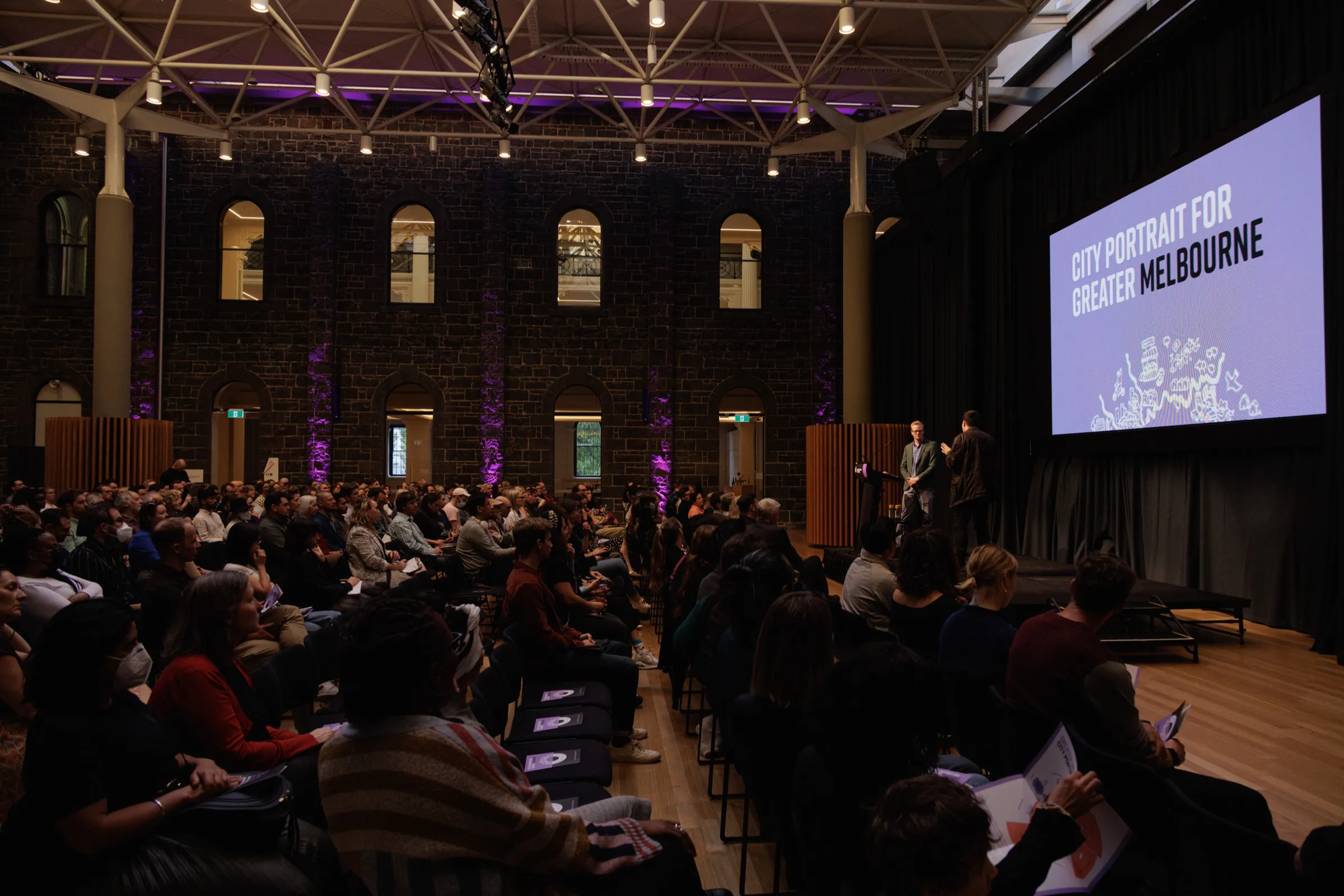
Large crowd at the City Portrait for Greater Melbourne launch in a heritage brick venue with purple lighting
Overall Portfolio
Metropolitan Governance
Leadership & Capability
Democratic Health & Participation

Overall Portfolio

Our work in Collaborative Research Ecosystems is made up of a Learning Portfolio made up of real research projects and partnerships which each have specific objectives as well as an emphasis on how they are shaped and conducted. The Learning Portfolio responds to three interconnected themes, each underpinned by supporting how-to learning questions.

Systemic Risks on the River

Systemic Risks on the Birrarung

How might centring the river as the subject of climate change adaptation surface the risks and costs of inaction and lead to its regeneration?
Data Optimising for Swimmability

Data Optimising for Swimmability

How can optimised data for the Birrarung Yarra River be used as a key input to decision making for the catchment?
Tomorrow's River

Tomorrow's River

How might reimagining our relationship with the Birrarung River unleash pathways for just and transformative adaptation futures?

Stormwater Sources

Where are the pathways of stormwater into the river and how can we better understand these in order to respond more effectively?
Connected Corridors

Connected Corridors

How can we better use and share public land in a way that meets social and ecological needs?
Transforming the Public Plate

Transforming the Public Plate

How can public investment be redirected to drive food system transformation that serves the environment, community health, and local livelihoods?
Resilience In-house

Resilience In-house

How might leadership archetypes support building community resilience in Melbourne's West?
Climate Resilience in Food Systems

Climate Resilience in Food Systems

How do we build spaces and conversations where actors from different but interdependent systems can discover shared purpose and take action together?

Relational Ecology

How might relational infrastructure enable better flows of knowledge in service of the public good - regeneration of the Birrarung River.

Climate Change Exchange

How might we create spaces that foster cross-sectoral collaborations to build our collective capacity to adapt to climate change and enable inclusive, just and transformative adaptation futures?
Riverbank

The Riverbank

How can we orchestrate capital to flow in service of a Swimmable Birrarung?
Indigenous Knowledge and Regenerative Practice

Indigenous Knowledge and Regenerative Practice

How can Indigenous understandings of relationality translate to and enhance regenerative practice?

Greater Melbourne City Portrait

How can we apply Doughnut Economics at a city scale to create measurable goals for long-term regeneration in Greater Melbourne?
Measuring Systemic Change

Measuring Systemic Change

How can we demonstrate and measure signals of directional, systemic change towards a regenerative future?
Risk, Sustainability and the Doughnut

Risk, Sustainability and the Doughnut

What role can the Doughnut play in supporting holistic modelling and decision-making that responds to risk and sustainability objectives?
Community Networks and Urban Resilience

Community Networks and Urban Resilience

How can community networks contribute to building urban resilience through engagement with infrastructure planning?

Overall Portfolio

Our work in Systemic Investment is made up of a Learning Portfolio that includes diverse finance and capital projects responsive to our Earthshots’ needs. At the same time, we are exploring what is required to shift paradigms and build capability across capital systems, in and beyond our city. The Learning Portfolio responds to interconnected themes, each underpinned by supporting how-to learning questions.

Greater Melbourne City Portrait

How can we apply Doughnut Economics at a city scale to create measurable goals for long-term regeneration in Greater Melbourne?
The Doughnut in Practice

The Doughnut in Practice

How can we apply Doughnut Economics to inform the narratives and decision-making associated with strategies and projects in practice?
Melbourne Invests in Systemic Transformation (MIST)

Melbourne Invests in Systemic Transformation

How do we shift the dominant narratives of capital and economic performance towards regeneration?
Systemic Risks on the River

Systemic Risks on the Birrarung

How might centring the river as the subject of climate change adaptation surface the risks and costs of inaction and lead to its regeneration?
Transforming the Public Plate

Transforming the Public Plate

How can public investment be redirected to drive food system transformation that serves the environment, community health, and local livelihoods?
Measuring Systemic Change

Measuring Systemic Change

How can we demonstrate and measure signals of directional, systemic change towards a regenerative future?
Riverbank

The Riverbank

How can we orchestrate capital to flow in service of a Swimmable Birrarung?
Capital Orchestration

Capital Orchestration

How can we orchestrate capital in service of a systems transformation?
Water Markets for Thriving Ecosystems

Water Markets for Thriving Ecosystems

How do we establish new financial markets that centre regeneration and net gain for the Birrarung?
Wellbeing capital

Wellbeing capital

How can we better equip community groups and leaders with the governance capabilities and funding needs to activate projects within their community?
Connected Corridors

Connected Corridors

How can we better use and share public land in a way that meets social and ecological needs?
Sensemaking the Greater Melbourne Food System

Sensemaking the Greater Melbourne Food System

How can a deep, adaptive, and relational approach to sensemaking accelerate food systems change across a city?

Overall Portfolio

Our work in New Urban Governance is made up of a Learning Portfolio that includes projects based within our Earthshots, giving them specificity and place-based context in Melbourne. At the same time, we are exploring some governance-related questions more broadly, where working in collaboration with partners at a conceptual level is important. The Learning Portfolio responds to three interconnected themes, each underpinned by supporting how-to learning questions.

Convener Catalyst

Convener Catalyst

What role do place-based conveners play in building trust and sustaining participation? How can we create the conditions for widespread, effective and sustainable local leadership?
Connected Corridors

Connected Corridors

How can we better use and share public land in a way that meets social and ecological needs?
School Streets

School Streets

How can we ensure radically inclusive futures where all communities shape and benefit from street transformation?
The Doughnut in Practice

The Doughnut in Practice

How can we apply Doughnut Economics to inform the narratives and decision-making associated with strategies and projects in practice?
Wellbeing capital

Wellbeing capital

How can we better equip community groups and leaders with the governance capabilities and funding needs to activate projects within their community?
Democracy Beyond the Ballot Box

Democracy Beyond the Ballot Box

How do we build the democratic muscle of Melburnians, strengthening their capability, capacity, trust, agency and willingness to participate in shaping the city?
Resilience In-house

Resilience In-house

How might leadership archetypes support building community resilience in Melbourne's West?
Earthshot Stewardship

Earthshot Stewardship

How might we test and demonstrate models of collective governance that can hold the complexity of transformational change?
Systemic Risks on the River

Systemic Risks on the Birrarung

How might centring the river as the subject of climate change adaptation surface the risks and costs of inaction and lead to its regeneration?
Governing Greater Melbourne

Governing Greater Melbourne

In the absence of metropolitan-level governance for Greater Melbourne, how might we test new models of governance that ensure better and more holistic decisions are made towards a regenerative future for the entire city and allow more people to participate in those decisions?

Stormwater Sources

Where are the pathways of stormwater into the river and how can we better understand these in order to respond more effectively?
Community Networks and Urban Resilience

Community Networks and Urban Resilience

How can community networks contribute to building urban resilience through engagement with infrastructure planning?
Sensemaking the Greater Melbourne Food System

Sensemaking the Greater Melbourne Food System

How can a deep, adaptive, and relational approach to sensemaking accelerate food systems change across a city?

Overall Portfolio

Our work in Measuring What Matters focuses on how to deploy measurement to enable long-term change to our understandings of, relationships with and decisions about our social, ecological and economic systems. We approach this through a ‘Learning Portfolio’, made up of real projects in practice which have a combined doing and learning emphasis. This work originated with our exploration of Doughnut Economics and development of the Greater Melbourne City Portrait as a way to holistically define and measure long-term goals for Melbourne’s regeneration. We continue to build on and draw from this work, while also considering how measurement can facilitate change and decision-making in real-time, through inclusive and democratic practices.

Testing the water

Testing the water

How can arts and culture, existing infrastructure along the river and citizen science be leveraged to collect required data to develop a water quality baseline for the river whilst taking the community on an educational journey about the river.
Data Optimising for Swimmability

Data Optimising for Swimmability

How can optimised data for the Birrarung Yarra River be used as a key input to decision making for the catchment?
Water Markets for Thriving Ecosystems

Water Markets for Thriving Ecosystems

How do we establish new financial markets that centre regeneration and net gain for the Birrarung?

Greater Melbourne City Portrait

How can we apply Doughnut Economics at a city scale to create measurable goals for long-term regeneration in Greater Melbourne?
Measuring Systemic Change

Measuring Systemic Change

How can we demonstrate and measure signals of directional, systemic change towards a regenerative future?

Stormwater Sources

Where are the pathways of stormwater into the river and how can we better understand these in order to respond more effectively?
The Doughnut in Practice

The Doughnut in Practice

How can we apply Doughnut Economics to inform the narratives and decision-making associated with strategies and projects in practice?
Risk, Sustainability and the Doughnut

Risk, Sustainability and the Doughnut

What role can the Doughnut play in supporting holistic modelling and decision-making that responds to risk and sustainability objectives?

Relational Ecology

How might relational infrastructure enable better flows of knowledge in service of the public good - regeneration of the Birrarung River.
Indigenous Knowledge and Regenerative Practice

Indigenous Knowledge and Regenerative Practice

How can Indigenous understandings of relationality translate to and enhance regenerative practice?

Overall Portfolio

Our work in New Narratives of Place is made up of a Learning Portfolio that includes real storytelling, media and narrative-building activities which have a combined doing and learning emphasis. The Learning Portfolio responds to two interconnected themes, each underpinned by supporting how-to learning questions.

Telling the Story of the Streets

Telling the Story of the Streets

What is a new urban story to spark collective demand for truly liveable streets across Greater Melbourne?

Sharing stories of the river

What would it take for a new urban story to spark collective demand for a thriving, healthy and swimmable Birrarung?
A New Food Story for Melbourne

A New Food Story for Melbourne

What would it take for a new urban story to spark collective demand for a truly nourishing food system?
The Row Boat + Swimmable Birrarung

The Row Boat + Swimmable Birrarung

How can arts and culture be used to explore and progress new areas of scholarship around more-than-human practices of place-connection and custodianship.
Tomorrow's River

Tomorrow's River

How might reimagining our relationship with the Birrarung River unleash pathways for just and transformative adaptation futures?
Climate Resilience in Food Systems

Climate Resilience in Food Systems

How do we build spaces and conversations where actors from different but interdependent systems can discover shared purpose and take action together?
Governing Greater Melbourne

Governing Greater Melbourne

In the absence of metropolitan-level governance for Greater Melbourne, how might we test new models of governance that ensure better and more holistic decisions are made towards a regenerative future for the entire city and allow more people to participate in those decisions?
Birrarung Riverfest

Birrarung Riverfest

How can arts and culture events such as festivals be leveraged to increase public awareness, connection and care for the Birrarung Yarra River?
The Doughnut in Practice

The Doughnut in Practice

How can we apply Doughnut Economics to inform the narratives and decision-making associated with strategies and projects in practice?
Melbourne Invests in Systemic Transformation (MIST)

Melbourne Invests in Systemic Transformation

How do we shift the dominant narratives of capital and economic performance towards regeneration?
School Streets

School Streets

How can we ensure radically inclusive futures where all communities shape and benefit from street transformation?

Greater Melbourne City Portrait

How can we apply Doughnut Economics at a city scale to create measurable goals for long-term regeneration in Greater Melbourne?

Models & Instruments

How research and learning occur is generally driven by the resources and structures available to support it. This theme focuses on how we can orient existing and new research instruments and models towards holistic, public-good outcomes. Our learning questions within this theme include:

  • How might research pathways and resourcing instruments be oriented and coordinated to centre regeneration?
  • How might deploy creative approaches to research translation to increase its effectiveness in policy and practice?
Tomorrow's River

Tomorrow's River

How might reimagining our relationship with the Birrarung River unleash pathways for just and transformative adaptation futures?

Climate Change Exchange

How might we create spaces that foster cross-sectoral collaborations to build our collective capacity to adapt to climate change and enable inclusive, just and transformative adaptation futures?

Relational Ecology

How might relational infrastructure enable better flows of knowledge in service of the public good - regeneration of the Birrarung River.
Riverbank

The Riverbank

How can we orchestrate capital to flow in service of a Swimmable Birrarung?
Data Optimising for Swimmability

Data Optimising for Swimmability

How can optimised data for the Birrarung Yarra River be used as a key input to decision making for the catchment?

Stormwater Sources

Where are the pathways of stormwater into the river and how can we better understand these in order to respond more effectively?
Climate Resilience in Food Systems

Climate Resilience in Food Systems

How do we build spaces and conversations where actors from different but interdependent systems can discover shared purpose and take action together?

Greater Melbourne City Portrait

How can we apply Doughnut Economics at a city scale to create measurable goals for long-term regeneration in Greater Melbourne?
Indigenous Knowledge and Regenerative Practice

Indigenous Knowledge and Regenerative Practice

How can Indigenous understandings of relationality translate to and enhance regenerative practice?
Risk, Sustainability and the Doughnut

Risk, Sustainability and the Doughnut

What role can the Doughnut play in supporting holistic modelling and decision-making that responds to risk and sustainability objectives?
Community Networks and Urban Resilience

Community Networks and Urban Resilience

How can community networks contribute to building urban resilience through engagement with infrastructure planning?
The Doughnut in Practice

The Doughnut in Practice

How can we apply Doughnut Economics to inform the narratives and decision-making associated with strategies and projects in practice?
Systemic Risks on the River

Systemic Risks on the Birrarung

How might centring the river as the subject of climate change adaptation surface the risks and costs of inaction and lead to its regeneration?

Relationality & Collaboration

Research and learning in response to complex challenges is most effective when understood as a practice that incorporates diverse perspectives and a sense of deeper connection. This theme focuses on how we can establish purpose-driven and integrated, relational approaches to research collaboration. Our learning questions within this theme include:

  • How might we foster collaborative learning practices that activate research for the public good?
  • How might we strengthen our understanding of relationality and reciprocity through research practices?
Systemic Risks on the River

Systemic Risks on the Birrarung

How might centring the river as the subject of climate change adaptation surface the risks and costs of inaction and lead to its regeneration?
Tomorrow's River

Tomorrow's River

How might reimagining our relationship with the Birrarung River unleash pathways for just and transformative adaptation futures?

Stormwater Sources

Where are the pathways of stormwater into the river and how can we better understand these in order to respond more effectively?
Connected Corridors

Connected Corridors

How can we better use and share public land in a way that meets social and ecological needs?
Resilience In-house

Resilience In-house

How might leadership archetypes support building community resilience in Melbourne's West?
Climate Resilience in Food Systems

Climate Resilience in Food Systems

How do we build spaces and conversations where actors from different but interdependent systems can discover shared purpose and take action together?
Transforming the Public Plate

Transforming the Public Plate

How can public investment be redirected to drive food system transformation that serves the environment, community health, and local livelihoods?

Relational Ecology

How might relational infrastructure enable better flows of knowledge in service of the public good - regeneration of the Birrarung River.
Indigenous Knowledge and Regenerative Practice

Indigenous Knowledge and Regenerative Practice

How can Indigenous understandings of relationality translate to and enhance regenerative practice?

Greater Melbourne City Portrait

How can we apply Doughnut Economics at a city scale to create measurable goals for long-term regeneration in Greater Melbourne?
Measuring Systemic Change

Measuring Systemic Change

How can we demonstrate and measure signals of directional, systemic change towards a regenerative future?

Climate Change Exchange

How might we create spaces that foster cross-sectoral collaborations to build our collective capacity to adapt to climate change and enable inclusive, just and transformative adaptation futures?
Risk, Sustainability and the Doughnut

Risk, Sustainability and the Doughnut

What role can the Doughnut play in supporting holistic modelling and decision-making that responds to risk and sustainability objectives?
Community Networks and Urban Resilience

Community Networks and Urban Resilience

How can community networks contribute to building urban resilience through engagement with infrastructure planning?

Research Purpose & Coherence

Creating new knowledge is key to addressing our current social and ecological needs, but current definitions of research impact, and institutional silos, limit the potential for public-good outcomes at-scale. This theme focuses on how we can integrate research effectively into challenge-led work and align expertise with critical social and ecological needs. Our learning questions within this theme include:

  • How might we activate research in service of challenge-led innovation?
  • How might we reshape the research ecosystem so its incentives respond to the pace and urgency of real-world challenges?
Systemic Risks on the River

Systemic Risks on the Birrarung

How might centring the river as the subject of climate change adaptation surface the risks and costs of inaction and lead to its regeneration?
Data Optimising for Swimmability

Data Optimising for Swimmability

How can optimised data for the Birrarung Yarra River be used as a key input to decision making for the catchment?
Tomorrow's River

Tomorrow's River

How might reimagining our relationship with the Birrarung River unleash pathways for just and transformative adaptation futures?

Stormwater Sources

Where are the pathways of stormwater into the river and how can we better understand these in order to respond more effectively?
Connected Corridors

Connected Corridors

How can we better use and share public land in a way that meets social and ecological needs?
Transforming the Public Plate

Transforming the Public Plate

How can public investment be redirected to drive food system transformation that serves the environment, community health, and local livelihoods?

Greater Melbourne City Portrait

How can we apply Doughnut Economics at a city scale to create measurable goals for long-term regeneration in Greater Melbourne?

Relational Ecology

How might relational infrastructure enable better flows of knowledge in service of the public good - regeneration of the Birrarung River.

Ecosystem Development & Capital Coordination

For the scale of change required over the long term, we need more than just pockets of capital activated in service of regeneration. This theme focuses on strengthening ecosystems of actors and building new markets that embed regenerative aspirations into their core objectives. Our learning questions within this theme include:

  • How might we support the establishment of an ecosystem that develops the future financial infrastructure and markets that centre regeneration?
  • How might we mature and equip ecosystems of actors with approaches for collective decision-making and coordinated resource distribution?
Riverbank

The Riverbank

How can we orchestrate capital to flow in service of a Swimmable Birrarung?
Water Markets for Thriving Ecosystems

Water Markets for Thriving Ecosystems

How do we establish new financial markets that centre regeneration and net gain for the Birrarung?
Transforming the Public Plate

Transforming the Public Plate

How can public investment be redirected to drive food system transformation that serves the environment, community health, and local livelihoods?
Melbourne Invests in Systemic Transformation (MIST)

Melbourne Invests in Systemic Transformation

How do we shift the dominant narratives of capital and economic performance towards regeneration?
Wellbeing capital

Wellbeing capital

How can we better equip community groups and leaders with the governance capabilities and funding needs to activate projects within their community?
Connected Corridors

Connected Corridors

How can we better use and share public land in a way that meets social and ecological needs?
Sensemaking the Greater Melbourne Food System

Sensemaking the Greater Melbourne Food System

How can a deep, adaptive, and relational approach to sensemaking accelerate food systems change across a city?
Capital Orchestration

Capital Orchestration

How can we orchestrate capital in service of a systems transformation?

Investment Infrastructure & Mechanisms

Unlocking capital in service of regeneration can’t just happen in the abstract - it requires real investment structures and instruments, including creative use of existing mechanisms and development of new ones. This theme focuses on developing, implementing and learning from innovative ways to direct capital to the health of our city’s communities and critical systems. Our learning questions within this theme include:

  • How might we develop new investment infrastructure that can facilitate systemic investment in place?
  • How might we create coordinated financing mechanisms that support the flow of capital in place and that centre alternative forms of value creation?
Riverbank

The Riverbank

How can we orchestrate capital to flow in service of a Swimmable Birrarung?
Capital Orchestration

Capital Orchestration

How can we orchestrate capital in service of a systems transformation?
Systemic Risks on the River

Systemic Risks on the Birrarung

How might centring the river as the subject of climate change adaptation surface the risks and costs of inaction and lead to its regeneration?
Water Markets for Thriving Ecosystems

Water Markets for Thriving Ecosystems

How do we establish new financial markets that centre regeneration and net gain for the Birrarung?
Wellbeing capital

Wellbeing capital

How can we better equip community groups and leaders with the governance capabilities and funding needs to activate projects within their community?
Connected Corridors

Connected Corridors

How can we better use and share public land in a way that meets social and ecological needs?

Investment Purpose & Value

Any systemic change to our financial system requires a fundamental shift in how we understand the purpose of finance and the economy, as well as more holistic definitions of what we value in financial markets. This theme focuses on these core definitional elements and how they can be reoriented to redirect capital flows. Our learning questions within this theme include:

  • How might we shift dominant paradigms about the purpose of our economic and financial systems towards regeneration?
  • How might we redefine and measure value, returns and impact to incorporate holistic social, ecological and economic outcomes?

Greater Melbourne City Portrait

How can we apply Doughnut Economics at a city scale to create measurable goals for long-term regeneration in Greater Melbourne?
The Doughnut in Practice

The Doughnut in Practice

How can we apply Doughnut Economics to inform the narratives and decision-making associated with strategies and projects in practice?
Melbourne Invests in Systemic Transformation (MIST)

Melbourne Invests in Systemic Transformation

How do we shift the dominant narratives of capital and economic performance towards regeneration?
Systemic Risks on the River

Systemic Risks on the Birrarung

How might centring the river as the subject of climate change adaptation surface the risks and costs of inaction and lead to its regeneration?
Transforming the Public Plate

Transforming the Public Plate

How can public investment be redirected to drive food system transformation that serves the environment, community health, and local livelihoods?
Measuring Systemic Change

Measuring Systemic Change

How can we demonstrate and measure signals of directional, systemic change towards a regenerative future?

Metropolitan Governance

Melbourne is a metropolitan city without a metropolitan governance layer, which generates ongoing challenges in planning and responding to challenges that do not respect municipal borders. This theme focuses on the structures and practices that can help bring greater coherence to decision-making at a Greater Melbourne scale. Our learning questions within this theme include:

  • What might new forums or institutions look like that can allow us to make better, community-informed and systems-oriented decisions about the future of Greater Melbourne?
  • How might we scale up democratic activity at a local level to the city level, to realise the vision of a safe, just and regenerative Greater Melbourne?
Systemic Risks on the River

Systemic Risks on the Birrarung

How might centring the river as the subject of climate change adaptation surface the risks and costs of inaction and lead to its regeneration?
Democracy Beyond the Ballot Box

Democracy Beyond the Ballot Box

How do we build the democratic muscle of Melburnians, strengthening their capability, capacity, trust, agency and willingness to participate in shaping the city?
Governing Greater Melbourne

Governing Greater Melbourne

In the absence of metropolitan-level governance for Greater Melbourne, how might we test new models of governance that ensure better and more holistic decisions are made towards a regenerative future for the entire city and allow more people to participate in those decisions?

Stormwater Sources

Where are the pathways of stormwater into the river and how can we better understand these in order to respond more effectively?
Connected Corridors

Connected Corridors

How can we better use and share public land in a way that meets social and ecological needs?
School Streets

School Streets

How can we ensure radically inclusive futures where all communities shape and benefit from street transformation?

Leadership & Capability

A future oriented towards regeneration requires new leadership formations and capabilities, moving beyond existing power structures and dynamics. This theme focuses on identifying and shaping new types of leaders and leadership and building connections across these to affect change at a city scale. Our learning questions within this theme include:

  • How might we identify and foster new forms of leadership required for regeneration?
  • How might we foster connection and coherence among community leaders across the city to amplify and embed new forms of leadership and the change they inspire?
Convener Catalyst

Convener Catalyst

What role do place-based conveners play in building trust and sustaining participation? How can we create the conditions for widespread, effective and sustainable local leadership?
Resilience In-house

Resilience In-house

How might leadership archetypes support building community resilience in Melbourne's West?
Earthshot Stewardship

Earthshot Stewardship

How might we test and demonstrate models of collective governance that can hold the complexity of transformational change?
Connected Corridors

Connected Corridors

How can we better use and share public land in a way that meets social and ecological needs?
Community Networks and Urban Resilience

Community Networks and Urban Resilience

How can community networks contribute to building urban resilience through engagement with infrastructure planning?
Sensemaking the Greater Melbourne Food System

Sensemaking the Greater Melbourne Food System

How can a deep, adaptive, and relational approach to sensemaking accelerate food systems change across a city?

Democratic Health & Participation

Our individual and collective wellbeing depends on the effectiveness of our democracy and its ability to respond to the needs of people and care for place - including and beyond elections. This theme focuses on both the health of our democratic systems and the ability of diverse people and communities to participate in them. Our learning questions within this theme include:

  • How might we work across the diversity of our communities to develop shared visions for a regenerative city?
  • How might we help people to better understand, navigate and shape our local, state and national government decision-making processes?
  • What tools, forums or institutions might make it easier for people to engage in decision-making, meeting citizens where they are?
  • How might we create opportunities for democratic participation at multiple scales (street, suburb, city) that rebuild trust in our democracy?
Convener Catalyst

Convener Catalyst

What role do place-based conveners play in building trust and sustaining participation? How can we create the conditions for widespread, effective and sustainable local leadership?
Connected Corridors

Connected Corridors

How can we better use and share public land in a way that meets social and ecological needs?
School Streets

School Streets

How can we ensure radically inclusive futures where all communities shape and benefit from street transformation?
The Doughnut in Practice

The Doughnut in Practice

How can we apply Doughnut Economics to inform the narratives and decision-making associated with strategies and projects in practice?
Wellbeing capital

Wellbeing capital

How can we better equip community groups and leaders with the governance capabilities and funding needs to activate projects within their community?
Democracy Beyond the Ballot Box

Democracy Beyond the Ballot Box

How do we build the democratic muscle of Melburnians, strengthening their capability, capacity, trust, agency and willingness to participate in shaping the city?
Governing Greater Melbourne

Governing Greater Melbourne

In the absence of metropolitan-level governance for Greater Melbourne, how might we test new models of governance that ensure better and more holistic decisions are made towards a regenerative future for the entire city and allow more people to participate in those decisions?

Application & Decision-making

Measurement is ultimately only useful if it is employed to inform policy, strategy and action. This theme focuses on how new and diverse measurement frameworks and approaches can be applied to enable systemic change. Our learning questions within this theme include:

  • How might we align new measurement frameworks with decision-making?
  • How might measurement support and facilitate change?
  • How might we incorporate new measurement frameworks into understandings of risk?
Testing the water

Testing the water

How can arts and culture, existing infrastructure along the river and citizen science be leveraged to collect required data to develop a water quality baseline for the river whilst taking the community on an educational journey about the river.
Data Optimising for Swimmability

Data Optimising for Swimmability

How can optimised data for the Birrarung Yarra River be used as a key input to decision making for the catchment?
Water Markets for Thriving Ecosystems

Water Markets for Thriving Ecosystems

How do we establish new financial markets that centre regeneration and net gain for the Birrarung?
The Doughnut in Practice

The Doughnut in Practice

How can we apply Doughnut Economics to inform the narratives and decision-making associated with strategies and projects in practice?
Measuring Systemic Change

Measuring Systemic Change

How can we demonstrate and measure signals of directional, systemic change towards a regenerative future?
Risk, Sustainability and the Doughnut

Risk, Sustainability and the Doughnut

What role can the Doughnut play in supporting holistic modelling and decision-making that responds to risk and sustainability objectives?

Greater Melbourne City Portrait

How can we apply Doughnut Economics at a city scale to create measurable goals for long-term regeneration in Greater Melbourne?

Stormwater Sources

Where are the pathways of stormwater into the river and how can we better understand these in order to respond more effectively?

Measurement Practices

Decisions about how and what we measure, who does the measuring and who has access to information are never entirely objective; they are informed explicitly or implicitly by the values and objectives of the decision-maker. This theme focuses on how measurement and data practices can be designed to be holistic and inclusive. Our learning questions within this theme include:

  • How might we create structures and practices that democratise measurement?
  • How do we measure meaningfully in a world of uncertainty and rapid change?
  • How might we understand and represent relationality in measurement?
Testing the water

Testing the water

How can arts and culture, existing infrastructure along the river and citizen science be leveraged to collect required data to develop a water quality baseline for the river whilst taking the community on an educational journey about the river.
Data Optimising for Swimmability

Data Optimising for Swimmability

How can optimised data for the Birrarung Yarra River be used as a key input to decision making for the catchment?
The Doughnut in Practice

The Doughnut in Practice

How can we apply Doughnut Economics to inform the narratives and decision-making associated with strategies and projects in practice?
Measuring Systemic Change

Measuring Systemic Change

How can we demonstrate and measure signals of directional, systemic change towards a regenerative future?
Risk, Sustainability and the Doughnut

Risk, Sustainability and the Doughnut

What role can the Doughnut play in supporting holistic modelling and decision-making that responds to risk and sustainability objectives?

Relational Ecology

How might relational infrastructure enable better flows of knowledge in service of the public good - regeneration of the Birrarung River.

Measurement Frameworks & Models

We need new, holistic measurement approaches that move us past narrow and harmful growth-centric models. This theme focuses on identifying and implementing measurement models that centre social and ecological wellbeing for setting goals and understanding change over time. Our learning questions within this theme include:

  • How might we adopt new measurement frameworks that are holistic and centre regenerative principles and objectives?
  • How might we capture evidence of systemic change over time?
Testing the water

Testing the water

How can arts and culture, existing infrastructure along the river and citizen science be leveraged to collect required data to develop a water quality baseline for the river whilst taking the community on an educational journey about the river.
Data Optimising for Swimmability

Data Optimising for Swimmability

How can optimised data for the Birrarung Yarra River be used as a key input to decision making for the catchment?
Water Markets for Thriving Ecosystems

Water Markets for Thriving Ecosystems

How do we establish new financial markets that centre regeneration and net gain for the Birrarung?

Greater Melbourne City Portrait

How can we apply Doughnut Economics at a city scale to create measurable goals for long-term regeneration in Greater Melbourne?
Measuring Systemic Change

Measuring Systemic Change

How can we demonstrate and measure signals of directional, systemic change towards a regenerative future?

Stormwater Sources

Where are the pathways of stormwater into the river and how can we better understand these in order to respond more effectively?
Indigenous Knowledge and Regenerative Practice

Indigenous Knowledge and Regenerative Practice

How can Indigenous understandings of relationality translate to and enhance regenerative practice?

Narrative-building Practices

Storytelling as a practice is as old as time; participating in shaping narratives continues to hold enormous potential to enable people and communities to build agency and collective identity. This theme focuses on how we can use the creation of stories as a change-making tool at local and city-wide scales. Our learning questions within this theme include:

  • How might we apply narrative-building as an approach to increase community agency and connection in urban transformation?
  • How might storytelling surface new understandings of place and our relationship to it?
The Row Boat + Swimmable Birrarung

The Row Boat + Swimmable Birrarung

How can arts and culture be used to explore and progress new areas of scholarship around more-than-human practices of place-connection and custodianship.
Birrarung Riverfest

Birrarung Riverfest

How can arts and culture events such as festivals be leveraged to increase public awareness, connection and care for the Birrarung Yarra River?
Tomorrow's River

Tomorrow's River

How might reimagining our relationship with the Birrarung River unleash pathways for just and transformative adaptation futures?
The Doughnut in Practice

The Doughnut in Practice

How can we apply Doughnut Economics to inform the narratives and decision-making associated with strategies and projects in practice?
Telling the Story of the Streets

Telling the Story of the Streets

What is a new urban story to spark collective demand for truly liveable streets across Greater Melbourne?
School Streets

School Streets

How can we ensure radically inclusive futures where all communities shape and benefit from street transformation?

Sharing stories of the river

What would it take for a new urban story to spark collective demand for a thriving, healthy and swimmable Birrarung?
A New Food Story for Melbourne

A New Food Story for Melbourne

What would it take for a new urban story to spark collective demand for a truly nourishing food system?
Climate Resilience in Food Systems

Climate Resilience in Food Systems

How do we build spaces and conversations where actors from different but interdependent systems can discover shared purpose and take action together?

Narratives & Change

The stories we tell, and are told, shape our beliefs and values, and in turn our relationships with each other and our environments. This theme focuses on developing and disseminating new stories of regeneration within our Earthshots, across Melbourne and in relation to our economic system. Our learning questions within this theme include:

  • What new narratives can describe and orient us towards a future where people and planet thrive in balance?
  • How might we use narrative and storytelling as foundations for systemic change?
Telling the Story of the Streets

Telling the Story of the Streets

What is a new urban story to spark collective demand for truly liveable streets across Greater Melbourne?

Sharing stories of the river

What would it take for a new urban story to spark collective demand for a thriving, healthy and swimmable Birrarung?
A New Food Story for Melbourne

A New Food Story for Melbourne

What would it take for a new urban story to spark collective demand for a truly nourishing food system?
The Row Boat + Swimmable Birrarung

The Row Boat + Swimmable Birrarung

How can arts and culture be used to explore and progress new areas of scholarship around more-than-human practices of place-connection and custodianship.
Tomorrow's River

Tomorrow's River

How might reimagining our relationship with the Birrarung River unleash pathways for just and transformative adaptation futures?
Climate Resilience in Food Systems

Climate Resilience in Food Systems

How do we build spaces and conversations where actors from different but interdependent systems can discover shared purpose and take action together?
Governing Greater Melbourne

Governing Greater Melbourne

In the absence of metropolitan-level governance for Greater Melbourne, how might we test new models of governance that ensure better and more holistic decisions are made towards a regenerative future for the entire city and allow more people to participate in those decisions?
Birrarung Riverfest

Birrarung Riverfest

How can arts and culture events such as festivals be leveraged to increase public awareness, connection and care for the Birrarung Yarra River?

Greater Melbourne City Portrait

How can we apply Doughnut Economics at a city scale to create measurable goals for long-term regeneration in Greater Melbourne?
Melbourne Invests in Systemic Transformation (MIST)

Melbourne Invests in Systemic Transformation

How do we shift the dominant narratives of capital and economic performance towards regeneration?
The Doughnut in Practice

The Doughnut in Practice

How can we apply Doughnut Economics to inform the narratives and decision-making associated with strategies and projects in practice?