.webp)
There is no shortage of models for change in the world, so this year we've been reviewing how this plurality of approaches can coalesce into a coherent living strategy for Regen Melbourne's work. Kaj and Nicole explain why we've chosen a periodic table to help us make sense of our unique alchemy.
Regen Melbourne is an engine for ambitious collaboration in service of the regeneration of Greater Melbourne. Our purpose is to move Melbourne towards a safe, just and regenerative future. As a result, Regen Melbourne's work sits at the intersection of many new models, frameworks, worldviews and approaches including Doughnut Economics, mission-oriented innovation, systems thinking, regenerative practice, collective impact, and inner practices that connect our personal development to the outer change we aspire to.
Importantly, one of the grounding ideas we keep coming back to is that "all models are wrong, but some are useful". There is no single model that can cure our world or build anew. Instead, we centre our work on our place, on the future of Greater Melbourne.
This year we have been reviewing how this plurality of approaches coalesce into a coherent overarching strategy. 20th century approaches to strategy are severely limited by linear theories of change, narrow boundaries, and first-order measurement frameworks.
"For some answers we turn to nature itself. Nature is beautiful, messy, non-linear, distributed and emergent."
The practices coming out of the new systems transformation landscape are yet to define tangible approaches to organisational strategy. There is a lot out there on emergent strategy that's incredibly important – we've drawn from adrienne maree brown, Henry Mintzberg and Nora Bateson. But from our experience there's an overemphasis towards intuitive strategy and emergence that risks being untethered from intentionality and structure.
So we are asking: How can we build a coherent organisational strategy for systems change when there is so much that is inherently uncertain?
For answers we turn to nature itself. As we develop and learn, we discover the periodic table of elements, the distillation of the fundamental building blocks of life itself. These elements don't all behave the same way. Some are abundant, some are scarce. Some are incredibly stable and strong, others are reactive and dynamic.
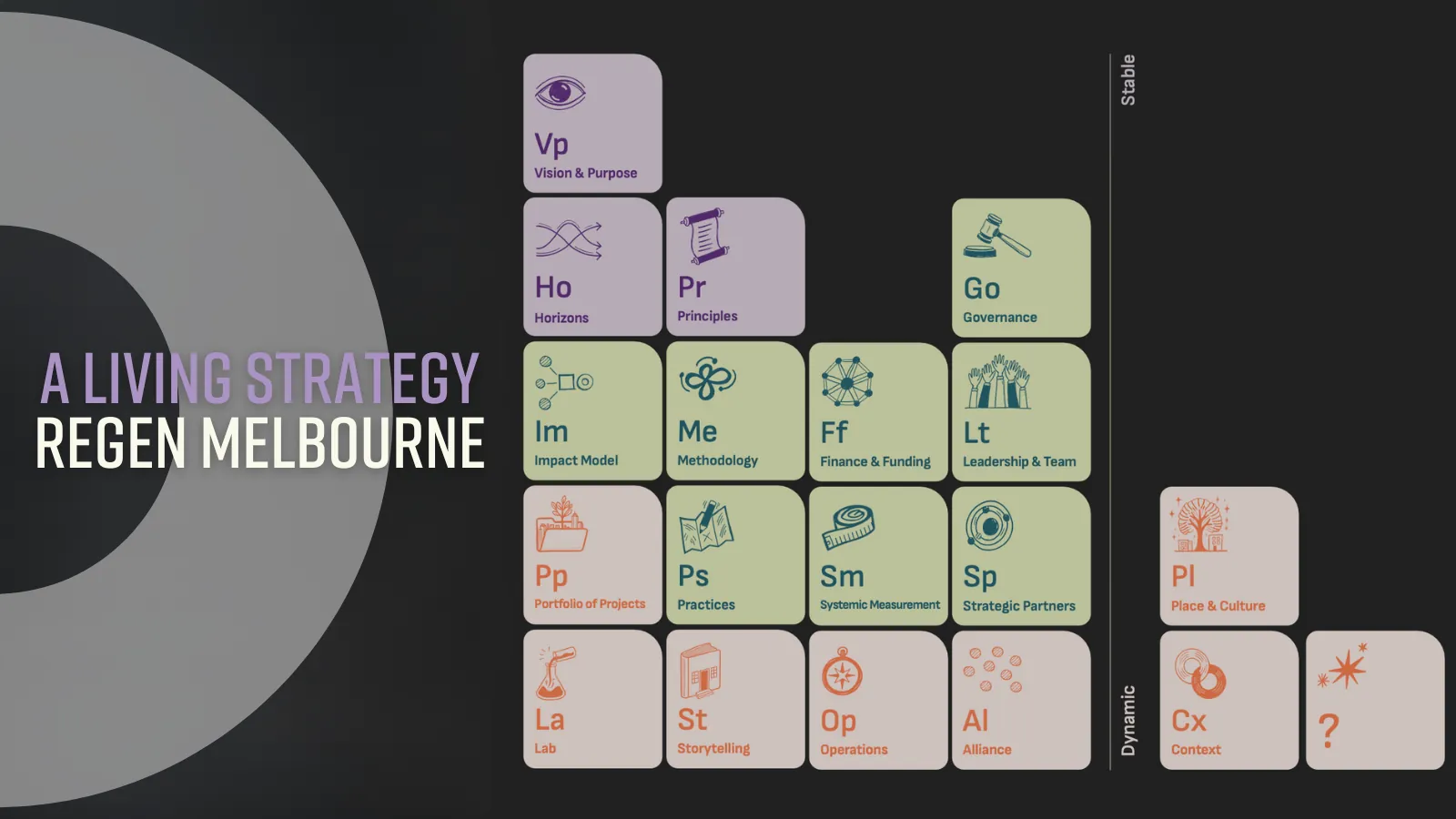
"We have built our new strategic model using the analogy of the periodic table."
We believe that our strategic model should be in conversation with the principles of systems thinking and regeneration. Just as in nature, certain elements of our strategy are stable and strong, and others are unstable and dynamic.
At the top of the RM periodic table you will see strategic elements like our vision and purpose (Vp), our Horizons (Ho), our principles (Pr) and our governance structure (Go). These are all highly stable elements. In contrast, as you work down you will find elements like our impact model (Im), our projects (Pp) and our operations (Op), becoming more dynamic.
In practice, our team (Lt), our board (Go) and our community (Al) can draw on constellations of these strategic elements to make decisions, guide their posture and create systemic impact.
In summary, we turned our strategy into a periodic table, which does three things:
It makes strategy more fun
It recognises the elemental, playful and emergent nature of systems work
It tethers us with a dynamic set of foundations we can rely on in uncertainty
We hope you can feel the chemistry.