.webp)
Co-Written by Kaj Löfgren & a collective of Regen Melbourne community members in February 2022.
"How are we as a society investing, stepping up and stepping forward to these disruptions that will continually impact on the world?" N'ARWEET DR CAROLYN BRIGGS, SENIOR ELDER BOON WURRUNG & REGEN MELBOURNE BOARD MEMBER
When the smoke arrived along the Birrarung Yarra River, so did the beginnings of Regen Melbourne.
In the final days of 2019, Melbourne was confronted with the devastating impacts of climate change in the form of thick smoke that blanketed our city – the result of unprecedented bushfires raging across large parts of the continent, including East Gippsland.
This apocalyptic experience of the Black Summer bushfires shook our understanding of Melbourne as a safe place, and brought the climate emergency directly to our doorsteps.
Weeks later, news of a deadly novel virus began to emerge, amplifying the sense that our ecological systems were breaking down and our social and economic systems were no longer able to keep us safe. Local responses were urgently needed.
As metropolitan Melbourne went into its first COVID-19 lockdown, a series of forums were convened by Small Giants Academy to explore the impact of the pandemic from all angles, recognising this moment as the biggest social and economic disruption since the Great Depression.
These conversations included a workshop featuring participants from around Australia, led by English economist Kate Raworth and her husband, philosopher Roman Krznaric. Kate is best known for creating the Doughnut Economics model, which seeks to find a balance between essential human needs and planetary boundaries. From that session, attendees committed to going back to their communities to explore ways to apply the model to Australian cities.
On the traditional lands of the Kulin Peoples, a diverse group of five organisations emerged to drive the local effort: Circular Economy Victoria, the City of Melbourne, the Lord Mayor's Charitable Foundation, Coalition of Everyone and Small Giants Academy. Along with a growing community, the group formed Regen Melbourne – conceived as a network and a community platform that could support the regeneration of the city.
Despite its profile as one of the world's most liveable cities, Melbourne is an unsustainable city, using vast amounts of resources and material flows to generate economic activity. This extractive and exploitative model urgently needs reimagining.
Melbourne also faces challenges such as homelessness, housing unaffordability, social injustice, income inequality and inequitable access to education, food, jobs and services.
It can be overwhelming to consider what comes next. Yes, we are in crisis. But history tells us that a crisis can catalyse positive change. Our current system will never return to what it was. It will transition. It's just a question of what it transitions to.
So, what can Regen Melbourne bring to the table?
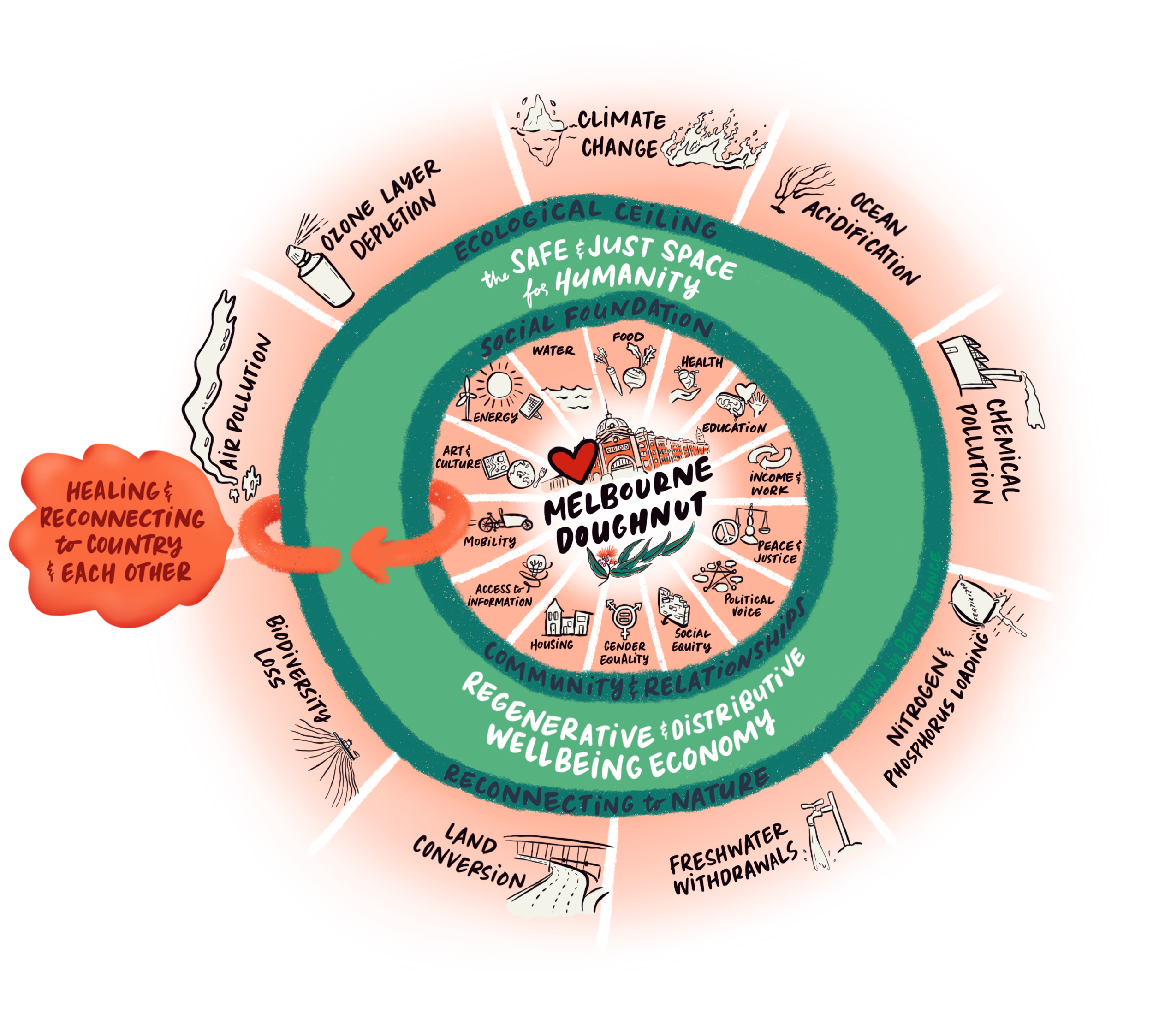
Our first move, in late 2020, was to explore how the Doughnut Economics model could connect with our culture and place. It equips us with a 21st Century compass for meeting the needs of all within the means of the planet.
We began the process of augmenting the original model to include several new elements. These changes included the addition of "Art & Culture" as a key element of our social foundation, alongside the expansion of "Networks" to "Mobility" and "Access to Information".
Throughout our workshops it became clear that the precursor to reaching the social foundation was a strong and vibrant community. We included "Community & Relationships" underpinning all aspects of our social foundation.
Similarly, we included "Reconnecting to Nature" as a critical addition to our ecological ceiling. Finally, we included a dynamic element entitled "Healing & Reconnecting to Country and Each Other."
Utilising the Melbourne Doughnut as our compass, Regen Melbourne has developed a roadmap and has grown into an operating network of individuals and organisations who are committed to working together.
Work has begun on collective impact projects like making the Birrarung Yarra River swimmable by 2030, and projects around food security and mobility in our city.
"How can we provide a society as a place of radical abundance, not artificial scarcity?" PROFESSOR YIN PARADIES, CHAIR OF RACE RELATIONS, DEAKIN UNIVERSITY
Regen Melbourne is a community platform where everyone can come together, listen and become actors in the regeneration of our local ecosystems, neighbourhoods and organisations.
Our community is asking a simple question: how can we serve Melbourne? We have a once-in-a-generation opportunity to create a new normal for our city, one that is regenerative, safe and just. We can all play a role.
Our collective vision at Regen Melbourne is a city that thrives within the ecological boundaries and provides social, cultural and economic prosperity for all. What happens next is up to us.
This piece was originally published as an article in Dumbo Feather.

.png)