.webp)
Recently we've been asking what is the role of civic participation in strengthening our democracy and our city? If we are to build a safe, just and regenerative Melbourne, we need to strengthen the civic muscle of our city and its citizens. We need to build on the many examples of civic participation already taking place in our streets and neighbourhoods and encourage more Melburnians to “do democracy” in ways that resonate with them and their communities.
What are we seeing?
While visible signs of community engagement can be seen all over Greater Melbourne, there is a general sense that our democracy is under threat, through declining trust and participation. There are pockets of meaningful, life-giving activity across the city, but much of it is disconnected and unable to shift the underlying economic and political system that is holding us back from our individual and collective potential.
Conversation and action (the thinking and the doing) is happening at multiple altitudes, from the global to the local:
- Community Participation: Often at a local level, Neighbourhood Houses like PRACE (Preston Reservoir Adult Community Education) continue to provide spaces for people to connect and to access much needed-services, in the face of funding uncertainty.
- Civic Participation: Organisations like Borderlands Collective are attempting to bring people back into decision-making to improve the places they live. The People’s Plan for Footscray is an emerging example of how organised communities working together can build their civic muscle, through developing skills and capabilities and exercising public power to make change.
- Political participation: At a national level, organisations like McKinnon and Foundations for Tomorrow are trying to elevate the discussion about the future of our democracy, and why a healthy democracy means more than just voting at the ballot box, but we are struggling to connect those conversations to the lives of everyday people.
What we are interested in is how all this participation comes together, in service of Greater Melbourne. How intentional must we be in directing this participation towards influencing and shaping power? Or is it enough to just create opportunities for people to come together to discuss what matters to them and their neighbourhoods, and then let a thousand flowers bloom? Can we expect that participation, in response to societal and environmental challenges, will organically scale up to political action? Or will it require organisations like Regen Melbourne to help join the dots, bring these spheres of activity together and build new spaces and institutions for collaboration and collective decision making at a city scale?
Why is strengthening our civic participation important for our democracy and for our city?
The issues that matter most to Melburnians - housing, transport, healthy waterways, the impacts of climate change, growing inequality - are systemic, long-term and require a collective response. But the spaces where we come together to discuss these issues are diminishing, replaced with “have your say” polls from councils or online forums, where algorithms drive people towards anger and tribalism rather than connectedness and healthy debate focused on shared needs and values.
At the same time, our democracy is under pressure. Across Australia, people are losing trust in political institutions, parties, politicians and the journalists that once held them to account and provided us with shared facts from which to create solutions to increasingly complex challenges. While many people continue to practice civic participation in organic and meaningful ways (for example by nominating for school council or president of their local sporting club) there are few ways to translate this local engagement into collective action, particularly at a city scale.
Our conventional political systems are based on the idea that elected politicians deliver for people — the essence of representative democracy — with citizens’ only real agency being to choose those politicians at election time. But if we are to create a safe, just and regenerative Melbourne, we need to weave a more active form of democracy into the fabric of our city.
We must create opportunities for Melburnians to not only talk about what democracy means for them and for Greater Melbourne, but also to “do democracy” - to play an active role in the decisions that shape our city.
We must also support multiple types of participation across our city. Community participation at a local level builds trust and connection and also lays the groundwork for more active civic participation. Civic participation harnesses the energy of local-level action to shift systems, reallocate power and form new institutions. Strengthening civic muscle across Greater Melbourne is necessary for positive political participation. Critically, political participation only serves a regenerative city if the mechanisms of our democracy are healthy and it is built on strong foundations. The lack of faith in our institutions sees a downward spiral of democratic participation, lessening their effectiveness.
Our work therefore is to build the civic muscle that allows for community and civic participation (software), whilst proposing and building a renewed democratic infrastructure that inspires participation in the formal roles of our city's governance (hardware).
Question 1: What is the relationship between community participation, civic participation and political participation?
There is a lot of talk going on around the decline of Australian democracy, but what does that actually mean? What is the link between “community participation” at a local level and “political participation” at a national level? Is the concept of “civic participation” a helpful bridge between the two?
%20(1080%20x%201080%20px)%20(1).png)
The categorisation above is not intended to be hierarchical, nor is each sphere completely separate from the other; rather we see each type of participation to be essential to different components of a healthy society.
What we are grappling with at Regen Melbourne is how these three concepts of community participation, civic participation and political participation interact with each other and how each can reinforce the other. We would argue that it is possible for community participation to be strong within an autocratic state; in fact reduced freedoms might inspire citizens to come together to take back their agency. Whereas a democracy cannot be strong without community engagement and civic participation.
What do you think? Is this typology useful in connecting conversations about “the health of our democracy” - which can sometimes feel academic and detached from our everyday lives – to the myriad of amazing activity taking place across Melbourne that is connecting people and improving the places they live?
Question 2: How do we strengthen our civic muscle?
Having established the importance of active participation, whether at a community level, city level or national level, we are also thinking through what it will take to strengthen Melbourne’s civic muscle. It is our contention that we need to build three things in parallel: “capability”, “capacity” and “care”.
- Capability - lifting levels of civic education among children and adults, through practical participation in decision making that affects people's lives. And upskilling politicians and bureaucrats to co-design solutions with community and make government more accessible, rather than an impenetrable black box.
- Capacity - creating new forums and institutions, where people can come together, from all walks of life, for respectful debate and discussion. This includes addressing the equity gap and meeting people where they are, so everyone who wants to participate can be involved, not only those with the means and power to do so.
- Care - the opposite of apathy. Optimism and a belief in the democratic system we all take for granted until it's gone. We need to create reasons for people to give a toss, and to be confident that if they put their shoulder to the wheel of democracy it won't be in vain and instead will lead to real and positive change. Again, starting at the local level can make democracy real and meaningful.
Each of these elements is critical to improving our connectedness as a society, strengthening our democracy and ensuring the best decisions are made in service of a safe, just and regenerative Melbourne.
The Earthshots being stewarded by Regen Melbourne, particularly 300,000 Streets, are exploring how we can provide tangible ways for Melburnians to activate their civic participation towards a goal; not just incidental engagement but a chance to roll up their sleeves and help create the conditions for a regenerative city: healthy waterways, nourishing food systems and thriving streets and neighbourhoods.
Is there anything missing here? What does this strengthening of our civic muscle actually look like in practice and what activities and interventions are going to have the biggest impact? What examples are you seeing across Melbourne?
Who else is active in this space?
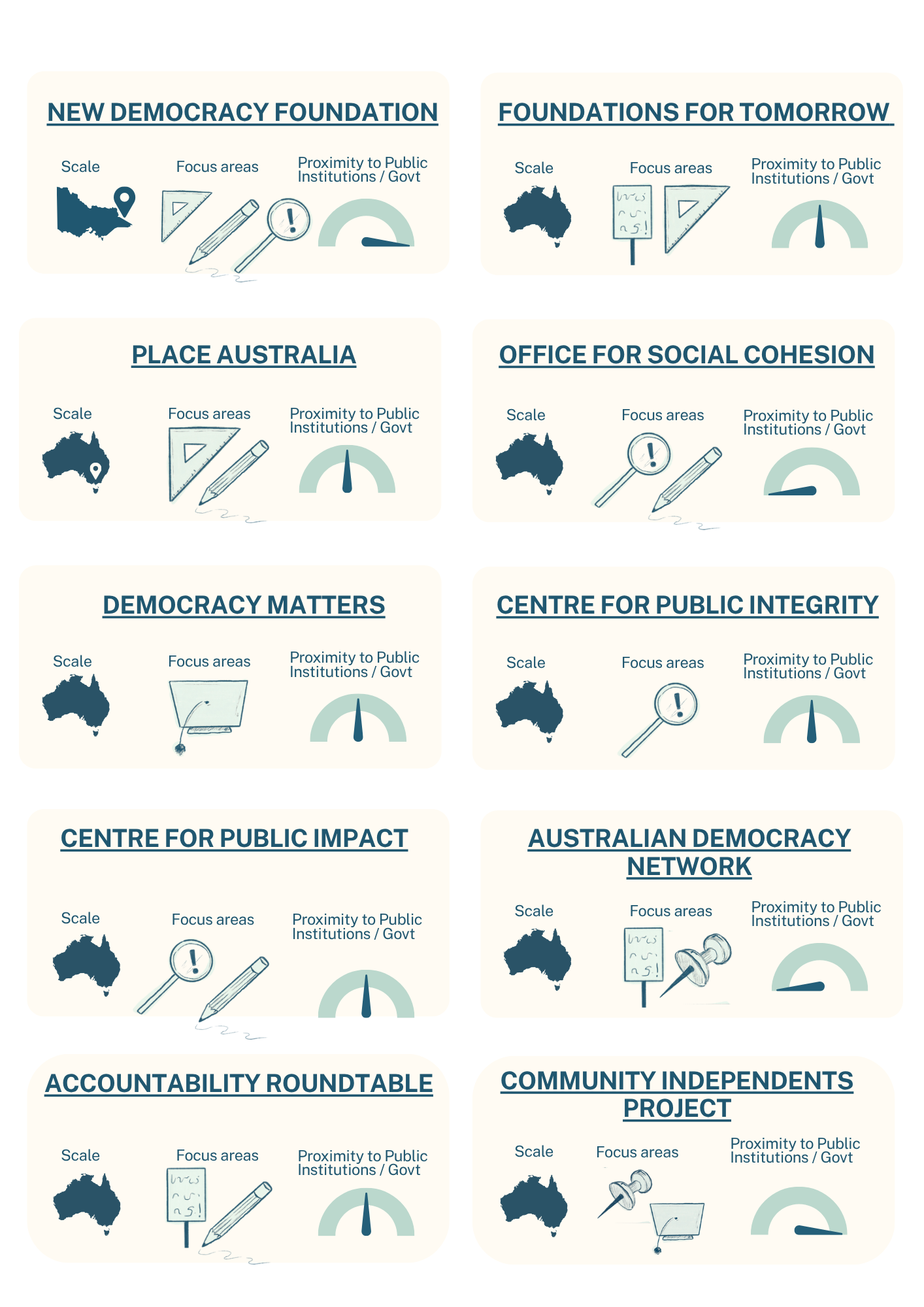
In grappling with the connections between community, civic and political participation, and how we connect the national to the local, the formal to the informal, we have been meeting with a range of organisations that are also active in this space. Through a combination of desktop research, attending events and sharing many coffees, we have put together a very non-exhaustive list of actors in the democracy ecosystem (see Figure 1 below). Some, like McKinnon (through their Democracy Matters campaign) and Foundations for Tomorrow (through their National Conversations) are working at a national level. Others, like Doing Co (formerly Town Teams Movement) and the Municipal Association of Victoria (through their Active Democracy work) are working at a more local level.
Who are we missing from this list? Who else should we be reaching out to?
Where to from here?
For Regen Melbourne, the need to strengthen our city’s civic muscle is central to many of the projects that we are designing through our three Earthshots: Swimmable Birrarung, Nourished Neighbourhoods and 300,000 Streets. We are also working with a range of partners who are also interested in questions of democracy and civic participation and how they land in place - in our streets, neighbourhoods and cities. Examples include:
- Connected Corridors: Transforming 1600 of underutilised public land into an ecological network that reconnects communities and ecosystems, and building novel forms of community governance to guide that work.
- Stewards Boards: Creating novel forms of governance where Board members are stewarding rather than directing ambitious projects, and in doing so creating opportunities for community, government and the private sector to come together to shift the big systems that shape Greater Melbourne.
- Convenor Catalyst: Working with local leaders to better understand how to support, catalyse and amplify their efforts in their own communities and - collectively - across the entire city.
As we do this work, we are continuing to ask some key questions. How do we connect the national to the local and the formal to the informal? How do we connect the emerging national conversation around the state of our democracy to the conversations taking place in community gardens, Neighbourhood Houses and across kitchen tables about the things that matter most to our citizens and our city?
If you are interested in being part of discussions and events hosted by Regen Melbourne on the topic of strengthening civic participation, please let us know by emailing joel@regen.melbourne.