.webp)

Nature strip gardening has a long and joyful history in Melbourne. We got curious about where this much-loved practice sits within city-wide transitions and decided to dig under the surface. Emily Tulloh joined Regen Melbourne as an intern last year and set out to do just that. Alongside Nina Sharpe and the 300,000 Streets team, Emily produced this handy snapshot of opportunity, and uncovered some fascinating learnings along the way.
When I joined the 300,000 Streets portfolio, Nina was busy exploring how hyper-local action (the kind that starts on our doorsteps) can begin to shift larger systems. She had identified verge (or nature strip) gardening as one of these transformative actions, based on all the stories we were hearing across Greater Melbourne. Nature strips are where we blur the boundary between the private and the public sphere, move from individuals to community, and begin to interact with other system actors, from our local council and utilities companies to community groups and Indigenous nurseries.
With bags of interest in civic participation and the role of community action to respond to our intersecting crises, we landed on a project. The brief? To dig into what nature strip planting can tell us about possibilities and benefits for broader change.
I started with a report pulled together by Melbourne Law School students as part of their studies in local questions: Annelise Adam, Ava Jackson, Lisa Wang and Yuwei Xu. They had already compared the nature strip planting policies of all 32 LGAs across Greater Melbourne, and put forward a recommended uniform policy and process. As a designer and researcher I was keen to build on this work through the gold dust that comes from meeting people out on the streets and hearing their stories.
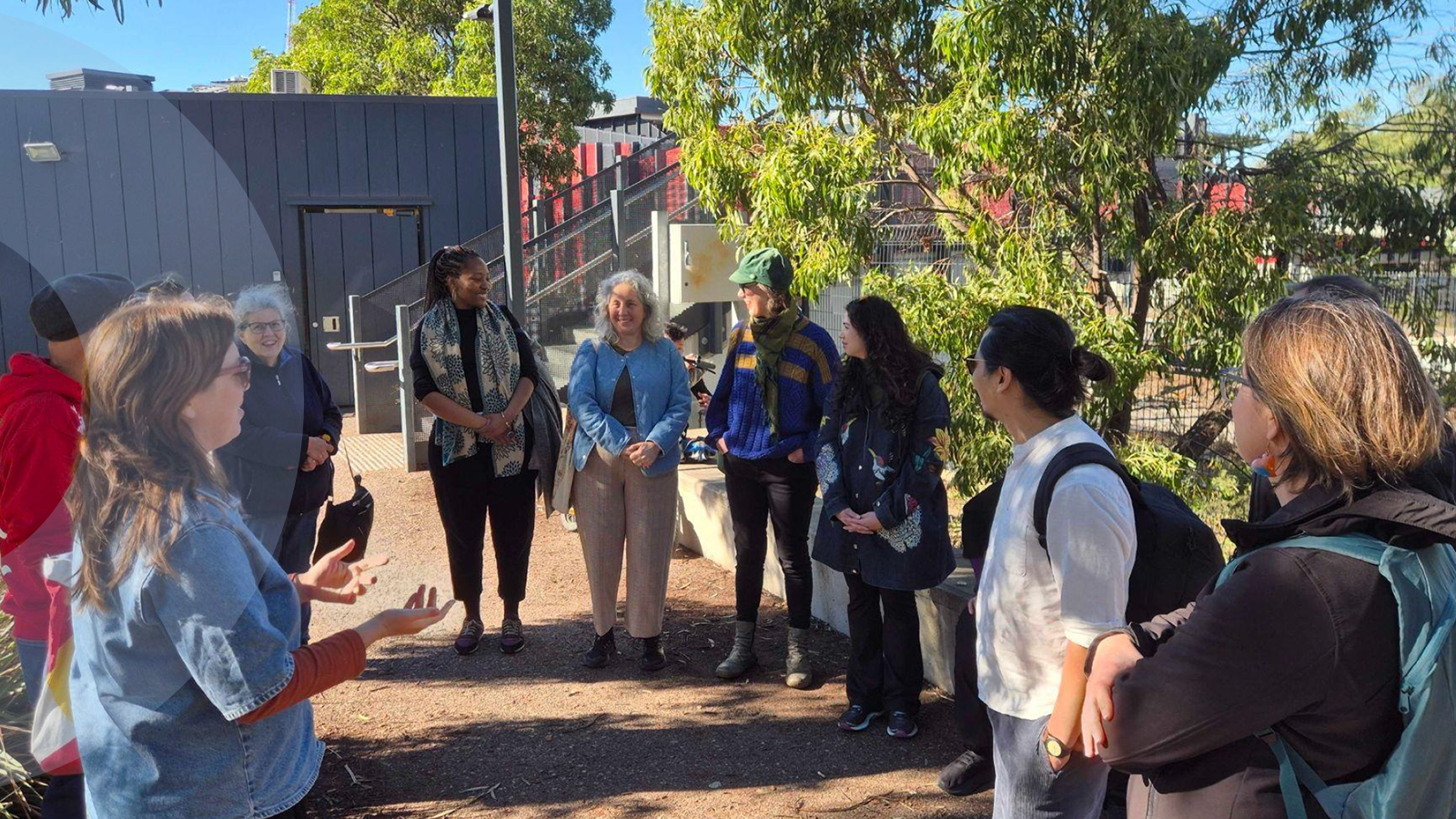
With the luxury of time and space as a volunteer I went wide. I met community groups and gardeners from all corners of Greater Melbourne. I met with passionate community volunteers in the west; went for coffees and street garden walking tours in the eastern suburbs; and participated in native nature-strip design workshops.
Here are five things we dug up about the holistic benefits of nature strip gardening along the way:
1. Governance is fragmented
Being new to Melbourne from the UK, I was really surprised to learn there is no metro-scale governance across the city, and that all local councils have their own policy and process. While there is collaboration across regions (like the Greenhouse Alliances) or the whole sector (like the Municipal Association of Victoria), there is no coordinating action happening across a Greater Melbourne scale. This feels like a major barrier to align action around our climate, biodiversity and place goals.
2. There are many (very strong) views on what nature strip gardening should be
These range from preferences for Indigenous no-dig gardens to colourful, exotic flowers for pollinators; and from using mechanical tools to hand tools only. At the beginning of this process, my instinct was to try and resolve these tensions –– for Regen Melbourne to put forward a synthesis and preferred position. Yet after being immersed in the Regen Melbourne way of thinking, I was led to embrace the complexity and tension that exists here, and view these differences as local democracy in action.
3. We need to value the 'intermediary'
Steph Ochona’s brilliant research shines a spotlight on the value of intermediaries –– a community organiser, or local community group –– to facilitate action, and move neighbours from being solely interested to getting their hands in the soil. Community groups and organisers can work much more flexibly and responsibly than council –– we saw this with the Green Guerilla Gardeners in Melbourne’s west, and Brunswick Communities for Nature. This role needs to be valued and resourced adequately.
4. Planting out nature strips builds relationships across shared spaces
Julie Mulhauser from Balwyn Rotary illustrated how nature strips can be a shared project that bring together local residents, community groups and councils –– and how these relationships can be the strong foundation for further local collaboration. So, yes, the end result has benefits for biodiversity and climate adaptation, but the relationships and connections formed along the way are just as powerful. An especially exciting provocation.
5. It's a transformative action that matches the scale of the challenges we face
Nature strips account for one third of green space in Greater Melbourne. For this reason, among others, it was clear that street gardening was a powerful lever of change, but could it really match the scale of our intersecting climate, biodiversity and mental health crises? In short, yes. Projects like Connected Corridors and Melbourne Pollinator Corridor are powerful examples of how nature strip planting can move from an isolated and individual activity to a collective activity in service of an ambitious vision: where our streets can be a powerful lever for change.
After working alongside Nina and the 300,000 Streets team, I'm convinced there is a pathway to transform turf monocultures into places for thriving biodiversity and community connection, street by street across Greater Melbourne.
Access: Activating streets through nature strip planting